Welcome to the Mental Health Public Awareness Campaign. This website is designed to introduce you to core principles of mental health and invite you to understand three treatments that go into aiding individuals with mental dilemmas and how it is applied to our current modern day situation. Mental health has had an upsurge in awareness in the last few decades but we would like to make known the process by which many people find success in treating it. Mental health is not solved by just one treatment, the mind is a very complex system and each individual has unique and personal qualities that come into play during treatment. We hope by introducing a few of them it can help expand your understanding of mental health as a whole and obtain a new perspective, reinforced with examples and research to help you be informed and spread reliable information to your friends and family.
What Exactly Is Mental Health?
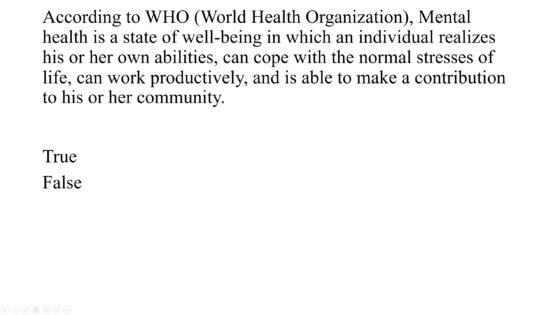
Well according to WHO (World Health Organization), Mental health is a state of well-being in which an individual realizes his or her own abilities, can cope with the normal stresses of life, can work productively, and is able to make a contribution to his or her community.

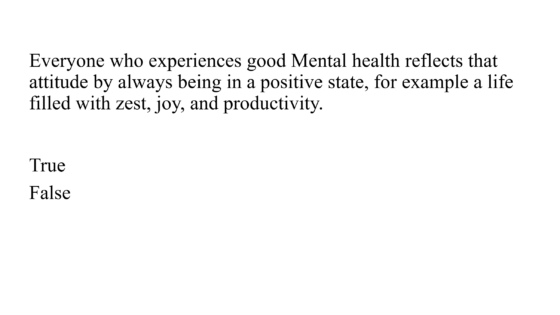
Although this definition does make progress when conceptualizing what mental health is about, it can be also interpreted as a state of an absence of mental illnesses, which also brings it’s share of misunderstandings to the table. People in “good mental health” are at times often sad, angry, unwell, or just plain unhappy but this is part of the human experience as we live life but in spite of this knowledge, mental health is usually correlated with positive affects attributed with feeling of happiness. Countless advertisements promise a life with zest, productivity, a life filled with love like a couple jumping for joy on a beach and the warm sunrise to their backs, this is far from the truth.
We would like to define mental health under a much more stricter and detailed concept with EQUILIBIUM as it’s main tenant proposed by WPA (World Psychiatry Association) “Mental health is a dynamic state of internal equilibrium which enables individuals to use their abilities in harmony with universal values of society. Basic cognitive and social skills; ability to recognize, express and modulate one’s own emotions, as well as empathize with others; flexibility and ability to cope with adverse life events and function in social roles; and harmonious relationship between body and mind represent important components of mental health which contribute, to varying degrees, to the state of internal equilibrium.”
Why Redefine Mental Health?

The previous definition does not take into consideration the complete and dynamic state of the human perspective. Productivity, pure positive affects, and societal contributions are arguably North American cultural points of views but many cultures have distinct values across the planet and these values play a huge roll in the life of the populace.
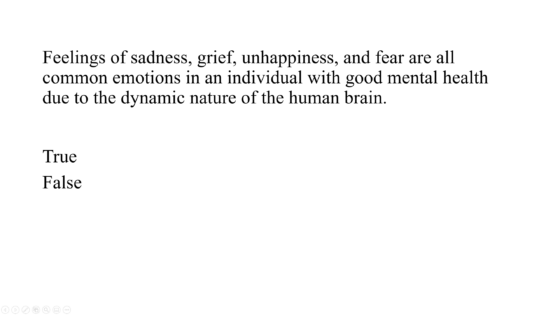
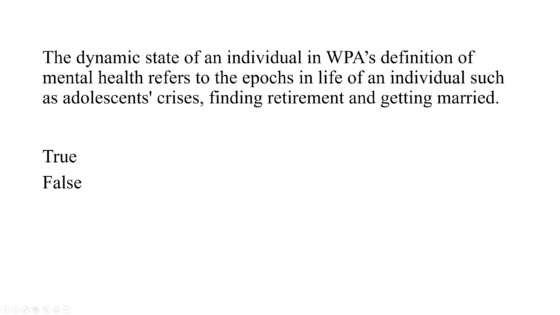
The dynamic state of an individual in this definition refers to the epochs in life for the individual because adolescents crises, finding retirement and getting married are new epochs in life where we must do an active search to find a new “mental equilibrium.” This concept makes it realistic in the sense that during these epochs in life we express common human emotions, such as fear, unhappiness, grief, and anger while also using resilience to restore the dynamic state that is an individuals’ internal equilibrium.
The quiz styled slide show below should help you understand the definition we want you to know while providing a fun activity before moving on.





Treatments
First and for most, these three treatments to mental health are not the only methods used or that should be used in the realm of mental treatment. They provided to help convey the idea that the complexity of the human mind requires more research from us. This is once again applied due to the dynamic nature of human life and our experiences in an effort to reach mental equilibrium. The three varied types of treatment should help you understand how flexible we should be with treatment and the way we communicate “good” mental health.



